Relative Positional Embedding
本文讲解基于transformer/conformer的语音识别Wenet中的Relative Positional Embed的实现
Relative Positional Embedding
Transformer XL中提出了Relative Positional Embedding方法,在ASR conformer论文中,也提到
We employ multi-headed self-attention (MHSA) while integrating an important technique from Transformer-XL [20],the relative sinusoidal positional encoding scheme. The relative po- sitional encoding allows the self-attention module to generalize better on different input length and the resulting encoder is more robust to the variance of the utterance length.
原始的带positional embedding的 attention score计算方法
i位置的encoding embedding为,positional embedding信息, i和j位置的attention score计算如下:
展开得到
去除和简化形式:
Relative Positional Embedding
相对位置这个概念,只有做attention时才存在, 使用表示第i个位置的query和第j个位置的key做attention时用的相对距离信息:
- 第3个位置的query和第2个位置的key做attention,使用R1.
- 第4个位置的query和第3个位置的key做attention,使用R1.
- 第4个位置的query和第2个位置的key做attention,使用R2.
在引入两个跟位置无关的可学习的向量参数u和v,将上述的带位置信息的attention score计算改写为:
合并ac项,bd项:
这个score matrix可以写成下面两项之和
ac项容易计算,这里只关注bd项, 为了表示方便,用代替, 同时令
一种计算 的方法是对于矩阵中的每一项分别计算。但是无法利用到GPU对大矩阵相乘加速的优点。有没有办法把矩阵 的计算变为矩阵乘法呢?可以使用下面方法
令
两个矩阵相乘,得
对该矩阵,将第i行左移L-i个位置,并且取前L列即得到
以上是一个长为L的序列中进行fully-attention的计算方式,对于的非流式E2E ASR系统,encoder部分使用上述fully-attention方法即可,对于流式的系统,一般可采用chunk-based,即当前chunk内的帧要和前面的帧以及本chunk内的帧做attention。在transformer-XL中,也是类似的方法: 当前长度为的segment和他前面长度为的memory以及自己segment内部的各个点做attention。
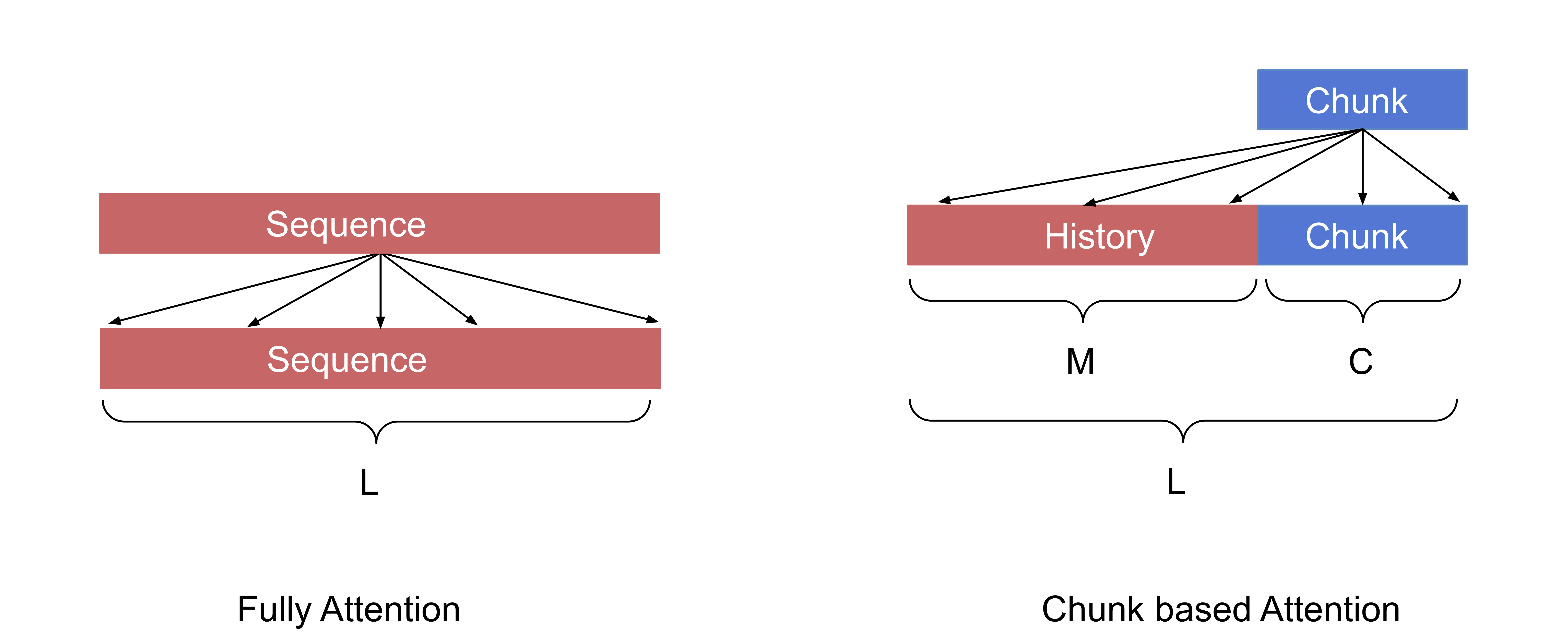
下面是chunk based attention下的计算方法,fully-attention只是chunk based attention的一个特例,即chunk size=整个序列长度的情况。
假设当前chunk的大小为,之前帧数为,则对于每个chunk,query的个数为个,key/value的个数为个。
只需将第行左移个位置即可得到对应的score matrix 令 ,则当前chunk的score matrix计算方式如下:
代码实现
产生Relative Positional Embedding
生成一个[-L,L]的Relative Positional Embedding的方法:
class RelPositionalEncoding():
    def __init__(self,
                    d_model: int,
                    dropout_rate: float,
                    max_len: int = 5000):
            super().__init__()
            self.d_model = d_model
            self.max_len = max_len

            self.pe = torch.zeros(self.max_len, self.d_model)
            position = torch.arange(0, self.max_len,
                                    dtype=torch.float32).unsqueeze(1)
            div_term = torch.exp(
                torch.arange(0, self.d_model, 2, dtype=torch.float32) *
                -(math.log(10000.0) / self.d_model))
            self.pe[:, 0::2] = torch.sin(position * div_term)
            self.pe[:, 1::2] = torch.cos(position * div_term)

    def position_encoding(self, size: int) -> torch.Tensor:
        assert size < int(self.max_len/2)
        mid_pos = int(self.max_len / 2)
        pos_emb = self.pe[mid_pos - size + 1:mid_pos + size]
        return pos_emb
Attention计算
利用上面生成的 长度的Relative Positional Embedding和Query Embeddings做矩阵乘法, 计算方式和Multi-Head Attention类似
def forward(self, query: torch.Tensor, key: torch.Tensor,
                value: torch.Tensor, pos_emb: torch.Tensor,
                mask: Optional[torch.Tensor]):
        """Compute 'Scaled Dot Product Attention' with rel. positional encoding.
        Args:
            query (torch.Tensor): Query tensor (#batch, time1, size).
            key (torch.Tensor): Key tensor (#batch, time2, size).
            value (torch.Tensor): Value tensor (#batch, time2, size).
            pos_emb (torch.Tensor): Positional embedding tensor
                (2*time2-1, size).
            mask (torch.Tensor): Mask tensor (#batch, time1, time2).
        Returns:
            torch.Tensor: Output tensor (#batch, time1, d_model).
        """
        q, k, v = self.forward_qkv(query, key, value)
        q = q.transpose(1, 2)  # (batch, time1, head, d_k)

        p = self.linear_pos(pos_emb).view(-1, self.h, self.d_k)  # (2*time2-1, head, d_k)
        p = p.transpose(0, 1)  # (head, 2*time2-1, d_k)

        # (batch, head, time1, d_k)
        q_with_bias_u = (q + self.pos_bias_u).transpose(1, 2)
        # (batch, head, time1, d_k)
        q_with_bias_v = (q + self.pos_bias_v).transpose(1, 2)

        # compute attention score
        # first compute matrix a and matrix c
        # as described in https://arxiv.org/abs/1901.02860 Section 3.3
        # (batch, head, time1, time2)
        matrix_ac = torch.matmul(q_with_bias_u, k.transpose(-2, -1))

        # compute matrix b and matrix d
        # (batch, head, time1, 2*time2 -1)
        matrix_bd = torch.matmul(q_with_bias_v, p.transpose(-2, -1))
        # Remove rel_shift since it is useless in speech recognition,
        # and it requires special attention for streaming.
        matrix_bd = self.rel_shift(matrix_bd)
        matrix_bd = matrix_bd[:, :, :, :matrix_ac.size(3)]
        scores = (matrix_ac + matrix_bd) / math.sqrt(
            self.d_k)  # (batch, head, time1, time2)

        return self.forward_attention(v, scores, mask)
其中matrix_bd的计算:
p = self.linear_pos(pos_emb).view(-1, self.h, self.d_k)  # (2*time2-1, head, d_k)
p = p.transpose(0, 1)  # (head, 2*time2-1, d_k)
matrix_bd = torch.matmul(q_with_bias_v, p.transpose(-2, -1))
matrix_bd = self.rel_shift(matrix_bd)
matrix_bd = matrix_bd[:, :, :, :matrix_ac.size(3)]
Attention Score矩阵左移操作
rel_shift会对一个矩阵进行左移操作。
    def rel_shift(self, x):
        """Compute relative positinal encoding.
        Args:
            x (torch.Tensor): Input tensor (batch, head, time1, time2)
            (batch, time, size).
            zero_triu (bool): If true, return the lower triangular part of
                the matrix.
        Returns:
            torch.Tensor: Output tensor.
        """
        zero_pad = torch.zeros((x.size(0), x.size(1), x.size(2), 1),
                               device=x.device,
                               dtype=x.dtype)
        x_padded = torch.cat([zero_pad, x], dim=-1)

        x_padded = x_padded.view(x.size(0),
                                 x.size(1),
                                 x.size(3) + 1, x.size(2))
        x = x_padded[:, :, 1:].view_as(x)
        return x
下面以C=3,L=4举例,
对于一个C x (2L-1)的矩阵,总共用C*(2L-1)个元素,
tensor([[[[ 1.,  2.,  3.,  4.,  5.,  6.,  7.],
          [ 8.,  9., 10., 11., 12., 13., 14.],
          [ 15., 16., 17., 18., 19., 20., 21.]]]])
每一行开头增加一个0,
tensor([[[[ 0.,  1.,  2.,  3.,  4.,  5.,  6.,  7.],
          [ 0.,  8.,  9., 10., 11., 12., 13., 14.],
          [ 0., 15., 16., 17., 18., 19., 20., 21.]]]])
变为C*(2L-1)+C个元素,然后将行列展开成一行,
tensor([ 0.,  1.,  2.,  3.,  4.,  5.,  6.,  7.,  0.,  8.,  9., 10., 11., 12.,
        13., 14.,  0., 15., 16., 17., 18., 19., 20., 21.])
去除开头的C个元素,
tensor([ 3.,  4.,  5.,  6.,  7.,  0.,  8.,  9., 10., 11., 12., 13., 14.,  0.,
        15., 16., 17., 18., 19., 20., 21.])
再排列成C x (2L-1)的矩阵。
tensor([[[[ 3.,  4.,  5.,  6.,  7.,  0.,  8.],
          [ 9., 10., 11., 12., 13., 14.,  0.],
          [15., 16., 17., 18., 19., 20., 21.]]]])
取前L列
tensor([[[[ 3.,  4.,  5.],
          [ 9., 10., 11.],
          [15., 16., 17.]]]])